
Cybersecurity is the practice of protecting devices, networks, applications, accounts, and data from unauthorized access, disruption, theft, and damage. In 2026, it is about more than installing antivirus software or building a firewall. Organizations must also manage AI-related risks, secure cloud services and software supply chains, protect digital identities, and prepare to recover quickly when an attack succeeds.
Whether you are an individual, a business owner, a student, or an aspiring cybersecurity professional, understanding the fundamentals can help you make safer decisions online.
In this guide: Learn what cybersecurity means, why it matters, the main types of cyber threats, the CIA triad, key security domains, practical defenses, and the trends shaping cybersecurity in 2026.
What is Cybersecurity
Cybersecurity is the combination of processes, people, policies, and technologies used to protect digital systems and information from cyber threats. It covers computers, smartphones, servers, networks, cloud platforms, websites, business applications, connected devices, and AI systems.
Cybersecurity overlaps with information security, but the terms are not identical. Information security protects information in any form, including physical records; cybersecurity focuses on digital systems, data, and connected environments.
The main goals of cybersecurity are to:
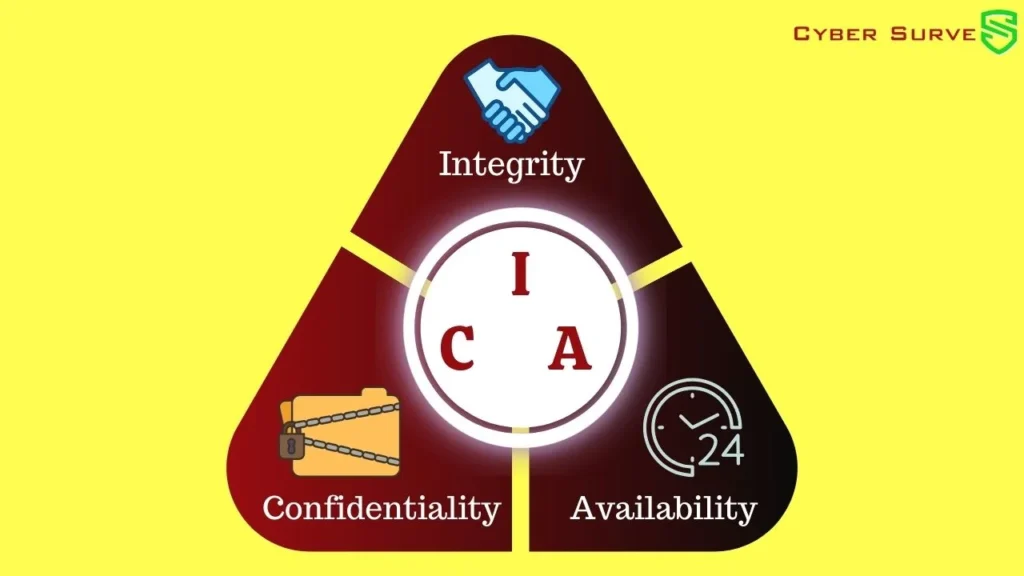
- Protect confidentiality: Make sure information is available only to authorized people and systems.
- Maintain integrity: Prevent unauthorized changes and preserve the accuracy and reliability of data.
- Ensure availability: Keep systems and information accessible to authorized users when needed.
- Support accountability and resilience: Record important activity, detect incidents, respond effectively, and restore services.
Cybersecurity is not a one-time installation. It is an ongoing risk-management process that includes identifying assets, reducing vulnerabilities, monitoring activity, responding to incidents, and learning from them..
Why Is Cybersecurity Important?
Cybersecurity matters because individuals and organizations depend on digital services for communication, banking, healthcare, education, commerce, public services, and daily work.
- Protecting sensitive information: Security controls help protect personal information, financial records, customer data, credentials, and intellectual property.
- Maintaining business continuity: Prepared organizations can reduce downtime and recover more effectively from ransomware, outages, and data loss.
- Protecting critical infrastructure: Power, transport, healthcare, telecommunications, and other essential services rely on dependable digital systems.
- Reducing fraud and identity theft: Strong account security helps limit account takeovers, payment fraud, and impersonation.
- Meeting legal and contractual obligations: Organizations must understand the privacy, security, and incident-reporting requirements that apply to their sector and location.
- Protecting trust and reputation: Customers and partners expect organizations to handle data responsibly and communicate clearly when incidents occur.
- Making AI adoption safer: AI tools and agents can access data and perform tasks, so their permissions, inputs, outputs, and actions need appropriate safeguards.
Cybersecurity is therefore a business and personal responsibility—not just an IT issue.
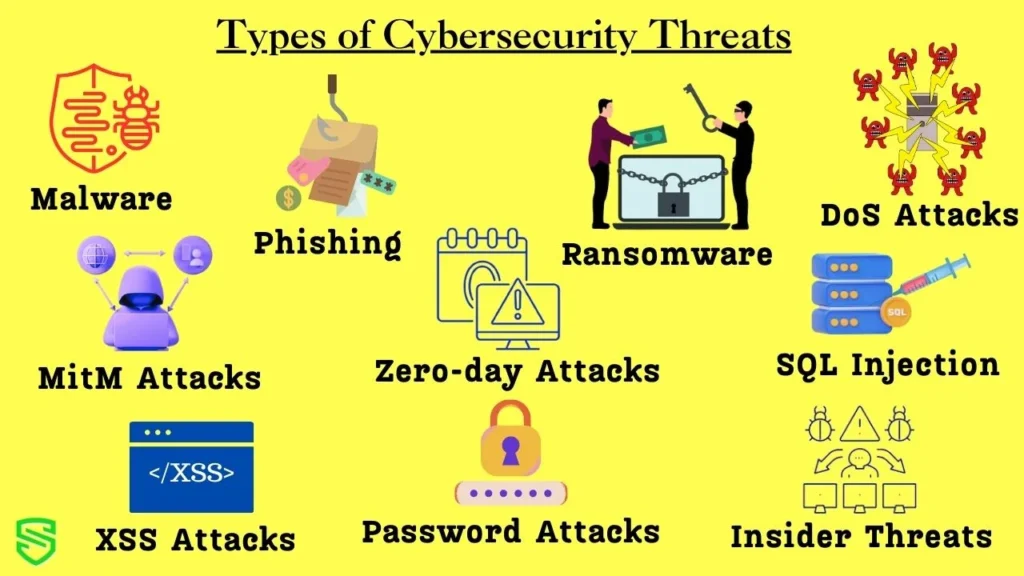
Common Cybersecurity Threats
Cyber threats vary in technique and impact. Many real-world incidents combine several methods, such as social engineering, stolen credentials, cloud misconfigurations, and data theft.
1. Malware
Malware is software designed to harm systems, steal information, spy on users, or gain unauthorized access. Common forms include viruses, worms, Trojans, spyware, and information stealers.
Protection: Keep systems updated, use reputable endpoint protection, download software only from trusted sources, and restrict unnecessary application permissions.
2. Phishing and Social Engineering
Phishing uses deceptive emails, messages, websites, or calls to trick people into revealing information or taking unsafe actions. Social engineering is the broader practice of manipulating people. Attackers may impersonate a bank, employer, delivery company, support agent, or colleague.
AI-generated text, voice cloning, and realistic images can make impersonation attempts more convincing. A message that looks polished is not necessarily genuine.
Protection: Verify unusual requests through a separate trusted channel, inspect domains carefully, avoid unexpected attachments, and use phishing-resistant multifactor authentication where possible.
3. Ransomware and Data Extortion
Ransomware can encrypt files or disrupt systems. Some attackers also steal data and threaten to publish it, even if the victim can restore from backups. Paying a ransom does not guarantee recovery or prevent disclosure.
Protection: Maintain isolated or immutable backups, test restoration, patch exposed systems, limit administrator privileges, and rehearse an incident-response plan.
4. Credential Theft and Account Takeover
Attackers steal passwords, session cookies, authentication tokens, or other credentials through phishing, malware, password reuse, or compromised services. Stolen credentials can let attackers appear to be legitimate users.
Protection: Use a password manager, unique passwords, passkeys or security keys where supported, multifactor authentication (MFA), and alerts for suspicious sign-ins. Protect sessions and tokens as carefully as passwords.
5. Denial-of-Service (DoS and DDoS)
A denial-of-service attack attempts to make a service unavailable. Distributed denial-of-service (DDoS) attacks use many systems or sources to overwhelm a target.
Protection: Use appropriate DDoS mitigation, traffic filtering, resilient architecture, monitoring, and a tested continuity plan.
6. Web Application and API Attacks
Poorly secured websites and application programming interfaces (APIs) may expose data or allow unauthorized actions. Examples include SQL injection, cross-site scripting (XSS), broken access control, insecure authentication, and excessive API permissions.
Protection: Follow secure development practices, validate inputs, enforce authorization on the server, manage secrets safely, test APIs, and remediate vulnerabilities based on risk. The OWASP Top 10 (https://owasp.org/www-project-top-ten/) is a useful starting point.
7. Zero-Day and Unpatched Vulnerabilities
A zero-day vulnerability is a flaw that is exploited before an effective fix is available or before the affected party has had a reasonable opportunity to address it. Separately, attackers often exploit known vulnerabilities simply because systems remain unpatched.
Protection: Maintain an accurate asset inventory, prioritize internet-facing and actively exploited vulnerabilities, apply updates promptly, and use compensating controls when immediate patching is not possible.
8. Insider Threats
Insider risk can come from malicious activity, mistakes, compromised employee accounts, or excessive permissions held by staff and contractors.
Protection: Apply least privilege, separate sensitive duties, review access regularly, monitor high-risk actions proportionately, and make reporting mistakes safe and straightforward.
9. Cloud and Software Supply-Chain Attacks
Attackers may target cloud identities, exposed storage, third-party software, code repositories, build systems, software dependencies, or service providers. A trusted supplier can become a path into many downstream organizations.
Protection: Review supplier security, secure development and build pipelines, scan dependencies, protect code-signing keys and secrets, and maintain a software bill of materials (SBOM) where appropriate.
10. AI-Related Security Threats
AI introduces risks such as prompt injection, sensitive-data exposure, insecure tool use, manipulated training or retrieval data, and unsafe actions by AI agents. Attackers can also use AI to help scale reconnaissance, create convincing scams, or adapt malicious content.
Protection: Treat AI output as untrusted until checked, restrict the data and tools an AI system can access, require approval for consequential actions, log agent activity, test against abuse, and keep human oversight for high-impact decisions.
The Impact of Cyberattacks
A cyber incident can affect far more than a computer or website. Common consequences include:
- Financial loss: Fraud, response costs, business interruption, recovery work, and legal expenses.
- Privacy violations: Exposure of personal, medical, financial, or confidential business data.
- Operational disruption: Delays to services, production, customer support, and essential operations.
- Reputational harm: Loss of trust among customers, employees, investors, and partners.
- Legal and regulatory consequences: Potential reporting duties, investigations, contractual disputes, or penalties depending on applicable law.
- Safety and national-security risks: Attacks on healthcare, industrial control systems, utilities, or government services can have physical consequences.
Small businesses, schools, charities, and individuals can be affected too. A proportionate security plan should reflect the value of the assets being protected, likely threats, and the impact of disruption.
How Cybersecurity Has Evolved
Cybersecurity has developed alongside computing and connectivity:
- 1960s–1970s: Early efforts emphasized physical protection, access controls, and securing shared computer systems.
- 1980s: Computer worms and viruses demonstrated that software could spread and disrupt systems.
- 1990s: Wider internet access and online commerce expanded the need for network security, secure websites, and user awareness.
- 2000s: Cybercrime became increasingly organized, while security operations, incident response, and professional standards matured.
- 2010s: Cloud adoption, mobile devices, large-scale data breaches, ransomware, and attacks on industrial systems broadened the security challenge.
- 2020–2024: Remote and hybrid work, software supply-chain incidents, cloud identity risks, and more capable social engineering increased the importance of identity, resilience, and secure development.
- 2025–2026: Organizations are placing greater emphasis on AI-enabled attacks and defense, AI-agent governance, identity and token security, cloud and SaaS exposure, supply-chain transparency, and recovery readiness. These are active trends, not a guarantee that every organization faces the same risks.
A useful modern framework is the NIST Cybersecurity Framework (CSF) 2.0, which organizes risk-management outcomes into six functions: Govern, Identify, Protect, Detect, Respond, and Recover. The Govern function highlights leadership, policy, accountability, and risk oversight. See the official NIST CSF 2.0 resources (https://www.nist.gov/cyberframework).
The Core Principles: The CIA Triad
The CIA triad is a foundational model for understanding information security.
Confidentiality
Only authorized people, devices, and services should be able to access protected information. Common controls include encryption, access permissions, MFA, and data classification.
Integrity
Data and systems should remain accurate, complete, and protected against unauthorized changes. Controls can include access restrictions, change management, cryptographic hashes, signed updates, and audit logs.
Availability
Authorized users should be able to access systems and data when required. Backups, redundancy, DDoS protection, capacity planning, disaster recovery, and tested incident procedures all support availability.
These goals can sometimes compete. For example, strict access restrictions may improve confidentiality but make a service harder to use. Good security balances the three according to risk and business needs.
Major Areas of Cybersecurity
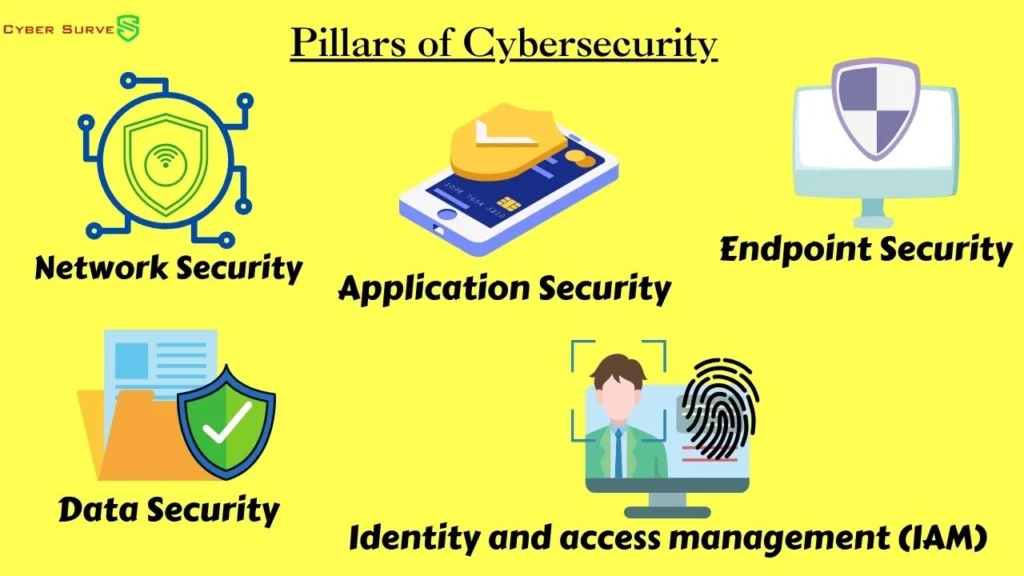
Cybersecurity is broader than five pillars. These areas overlap and work together.
1. Network Security
One of the key pillars of cybersecurity is network security, which helps protect systems and data from unauthorized access.
2. Application and API Security
Protects software throughout its lifecycle—from design and coding to testing, deployment, and maintenance. It includes secure coding, code review, dependency management, API authorization, and security testing.
3. Endpoint Security
Protects laptops, desktops, phones, servers, and other devices. Endpoint detection and response (EDR) and extended detection and response (XDR) can help security teams investigate suspicious activity and coordinate response.
4. Data Security and Privacy
Protects information throughout its lifecycle: collection, storage, use, sharing, retention, and deletion. Controls include encryption, access management, data-loss prevention, classification, backups, and privacy-aware data handling.
5. Identity and Access Management (IAM)
Manages identities and what each identity is allowed to do. Modern IAM includes MFA, single sign-on, role- or attribute-based access controls, privileged access management, passkeys, and governance of non-human identities such as service accounts and AI agents.
6. Cloud and SaaS Security
Secures cloud infrastructure, hosted applications, storage, containers, APIs, and cloud identities. Organizations need clear responsibility boundaries, secure configurations, logging, workload protection, and regular reviews of permissions.
7. Security Operations and Incident Response
Security operations teams monitor alerts, investigate suspicious activity, contain incidents, and coordinate recovery. They may use a security information and event management (SIEM) platform, EDR/XDR tools, threat intelligence, and carefully governed automation.
8. Governance, Risk, and Compliance
Sets security priorities, assigns accountability, evaluates risk, manages suppliers, and tracks legal or contractual obligations. Frameworks help organize this work, but no framework or certification automatically guarantees security.
9. AI Security
Protects AI models, data, prompts, retrieval systems, connected tools, and agent workflows. It includes threat modeling, access restrictions, evaluation, monitoring, privacy protection, and controls on actions that could affect real systems or people.
Essential Cybersecurity Practices and Technologies
No single product can stop every attack. Effective security combines technical controls, sound processes, and informed people.
Firewalls and Network Segmentation
Firewalls enforce traffic rules between systems or networks. Segmentation limits how far an attacker can move if one device or account is compromised.
Intrusion Detection and Prevention
IDS tools detect suspicious activity; IPS tools can block some malicious traffic. Their effectiveness depends on correct configuration, good visibility, and timely investigation.
Endpoint Protection, EDR, and XDR
Antivirus can detect many known and suspicious files. EDR adds deeper endpoint monitoring and investigation capabilities, while XDR correlates signals across multiple security layers. These tools support—but do not replace—patching, least privilege, and incident response.
Encryption and Key Management
Encryption helps protect data at rest and in transit. Organizations must also protect encryption keys, manage access, and plan for recovery if keys are lost or compromised.
Password Managers, Passkeys, and MFA
Use unique passwords for every account and store them in a reputable password manager. Where available, passkeys or hardware security keys can provide stronger resistance to phishing than passwords alone. MFA adds another barrier, though not all MFA methods offer the same protection.
Patch and Vulnerability Management
Track hardware, software, cloud assets, and dependencies. Prioritize fixes according to exploit activity, exposure, asset importance, and potential impact—not just a vulnerability score.
Secure Software Development
Build security into design, coding, code review, testing, deployment, and maintenance. Protect source-code repositories and build systems, scan dependencies, secure secrets, and review third-party components.
Backup and Recovery
Keep multiple backups, protect at least one copy from routine administrator access or alteration, and regularly test restoration. A backup strategy is incomplete until recovery has been demonstrated.
Security Awareness and Verification
Train people to recognize phishing, impersonation, unsafe file sharing, and suspicious requests. Use practical exercises and make it easy to report potential incidents without blame.
Monitoring and Incident Response
Collect useful logs, establish alerting, define incident roles, and rehearse scenarios such as a compromised account, ransomware, or cloud data exposure. Automation should be tested and constrained so it does not create a larger incident.
Cybersecurity Challenges and Trends in 2026
The following trends are prominent in current 2026 guidance and reporting. Their relevance varies by organization, sector, and threat model.
1. AI-Assisted Attacks and AI-Enabled Defense
Attackers can use AI to speed up research, personalize scams, translate messages, or help automate parts of an attack. Defenders use AI to summarize alerts, correlate events, support investigations, and assist analysts.
What to do: Use AI as an assistant rather than an unquestioned authority. Validate findings, protect sensitive data sent to AI services, evaluate false positives and false negatives, and require approval for high-impact automated actions.
2. AI Agents and Non-Human Identities
AI agents and automated workflows may access files, APIs, code repositories, and business applications. This creates a need to identify each agent, assign an owner, restrict its permissions, and record what it does. Uncontrolled or unapproved agents can create “shadow AI” risks.
What to do: Maintain an inventory of approved AI systems and agents, use least-privilege access, separate credentials, set action limits, log activity, and require human approval for sensitive or irreversible operations.
3. Identity, Tokens, and Session Security
A valid account, stolen session cookie, or exposed API token can bypass controls focused only on the network perimeter. Identity is increasingly central to cloud, SaaS, remote work, and automated services.
What to do: Prefer phishing-resistant MFA, protect and rotate secrets, shorten token lifetimes where appropriate, monitor unusual behavior, remove dormant accounts, and review privileged access.
4. Ransomware, Data Theft, and Extortion
Extortion can involve stolen data, threatened disclosure, disruption, and pressure on customers or partners. A functioning backup may help restore operations, but it does not necessarily resolve data exposure.
What to do: Secure backups, test recovery, segment networks, limit privileges, monitor data access and outbound transfers, and prepare legal, communications, and operational response plans.
5. Cloud, SaaS, and Hybrid-Environment Risks
Organizations increasingly depend on cloud platforms and third-party applications. Misconfigured storage, excessive permissions, exposed secrets, insecure integrations, and weak monitoring can expose data even when the underlying cloud provider is secure.
What to do: Use secure configuration baselines, centralize identity and logging, review OAuth and third-party app permissions, scan for exposed secrets, and assign clear ownership for each cloud service.
6. Software Supply-Chain Security
Applications rely on open-source packages, commercial vendors, build pipelines, and external services. Compromise at one point can affect many downstream users.
What to do: Assess supplier risk, pin and verify dependencies where appropriate, protect CI/CD pipelines, sign and verify artifacts, monitor vulnerabilities, and use SBOMs to understand components in software and AI systems.
7. Secure-by-Design Development and API Security
Security is more effective when built into products instead of being added only after release. APIs need particular attention because they often expose data and actions directly to other systems.
What to do: Make secure defaults standard, enforce server-side authorization, minimize exposed functionality, conduct threat modeling and testing, and fix recurring design flaws rather than relying only on perimeter defenses.
8. Operational Technology and Critical Infrastructure
Industrial control systems, healthcare equipment, building systems, and other operational technology may have long lifecycles and availability or safety constraints. They cannot always be patched like ordinary office computers.
What to do: Inventory assets, segment operational networks, control remote access, test changes safely, monitor critical systems, and coordinate cyber response with operational and safety teams.
9. Post-Quantum Cryptography Readiness
Large-scale quantum computers capable of breaking some widely used public-key cryptography are not a routine capability today, but migration planning takes time. Sensitive information that must remain confidential for many years may warrant early assessment.
What to do: Inventory cryptographic systems and dependencies, identify long-lived sensitive data, track recognized standards and vendor roadmaps, and plan migration with qualified experts. Avoid claims that all current encryption is already broken.
10. Regulation, Privacy, and Cybersecurity Governance
Organizations must understand the laws and contractual requirements that apply to their activities. In India, relevant resources include CERT-In’s cybersecurity directions and the Digital Personal Data Protection Act, 2023, together with the notified DPDP Rules, 2025 and their phased commencement schedule. Applicability and effective dates should be checked against official notifications. Other jurisdictions have their own requirements, such as the GDPR in the European Union and sector-specific rules.
What to do: Maintain a current obligations register, assign owners, preserve evidence and logs, test incident reporting processes, and seek qualified legal advice for jurisdiction-specific decisions. This article is educational and is not legal advice.
11. Skills, Staffing, and Cyber Resilience
Organizations need people who can understand risk, secure systems, investigate incidents, communicate clearly, and adapt as technology changes. Tooling alone does not replace sound judgment or practiced procedures.
What to do: Invest in ongoing training, tabletop exercises, cross-functional collaboration, and realistic recovery drills. Small organizations can start with a prioritized baseline rather than attempting to deploy every enterprise tool.
The Future of Cybersecurity
Cybersecurity will continue to evolve as AI, cloud services, connected devices, and software ecosystems develop. Several priorities are likely to remain important:
- Risk-led governance: Leadership must understand which services and data matter most, who owns the risks, and what level of disruption is tolerable.
- Zero Trust: Do not grant access solely because a user or device is inside a network. Verify identity and context, grant least privilege, and reassess access as risk changes.
- Human-supervised automation: AI can help with triage and repetitive tasks, but consequential actions need safeguards, testing, audit trails, and clear accountability.
- Resilience and recovery: Assume that some controls may fail. Practice containing incidents and restoring trusted services.
- Secure-by-design products: Build security and privacy into software architecture, defaults, development, and maintenance.
- Cryptographic agility: Prepare to update cryptographic algorithms and systems as standards and risks evolve.
- Collaboration: Share actionable threat intelligence responsibly and coordinate across organizations, suppliers, and public agencies.
The objective is not to eliminate every possible risk. It is to reduce likely risks, limit the impact of incidents, and recover safely.
A Practical Cybersecurity Checklist
For individuals
- ☐ Use a password manager and unique passwords.
- ☐ Turn on MFA or passkeys for email, banking, cloud storage, and social accounts.
- ☐ Install operating-system, browser, and application updates.
- ☐ Verify unexpected payment, password-reset, and account-recovery requests independently.
- ☐ Back up important files and test that you can restore them.
- ☐ Review app permissions, account recovery options, and active sessions.
- ☐ Avoid sending sensitive personal or business information to unapproved AI tools.
For small businesses and organizations
- ☐ Inventory devices, software, cloud services, important data, and suppliers.
- ☐ Require MFA for email, remote access, administrators, and critical services.
- ☐ Remove unnecessary access and review privileged accounts.
- ☐ Patch internet-facing and actively exploited systems promptly.
- ☐ Protect backups from alteration and test recovery.
- ☐ Centralize key logs and define who responds to alerts.
- ☐ Create and rehearse an incident-response plan.
- ☐ Review supplier access, software dependencies, and AI tools.
- ☐ Document applicable privacy, reporting, and contractual obligations.
- ☐ Train staff to report suspicious activity quickly.
Start with the controls that reduce the greatest risks for your situation. Review the checklist regularly as systems and threats change.
FAQs
Further Reading and Official Resources
- NIST Cybersecurity Framework 2.0 (https://www.nist.gov/cyberframework) — a practical framework for managing cybersecurity risk.
- Google Cloud Cybersecurity Forecast 2026 (https://cloud.google.com/security/resources/cybersecurity-forecast) — perspectives on AI, extortion, identity, and emerging threats.
- OWASP Top 10 (https://owasp.org/www-project-top-ten/) — common web application security risks.
- CISA Secure by Design (https://www.cisa.gov/securebydesign) — guidance on building products with security as a core requirement.
- CERT-In (https://www.cert-in.org.in/) — India’s national agency for cyber incident response and official advisories.
- MeitY: Digital Personal Data Protection Act and Rules (https://www.meity.gov.in/dpdp-rules-2025) — official Indian data-protection resources.
Conclusion
Cybersecurity is the ongoing work of protecting digital systems, information, and people while keeping essential services dependable. In 2026, effective protection combines proven fundamentals—strong identity controls, timely updates, secure development, backups, monitoring, and user awareness—with newer priorities such as AI-agent governance, cloud and supply-chain security, and post-quantum readiness.
The best starting point is to understand what you need to protect, identify the most realistic risks, apply controls in order of priority, and practice how you would respond if something went wrong. Security improves through consistent, measurable work—not through any single tool or product.


Pingback: Why Cloud Security Is Important For An Organization - Cyber Surve
Pingback: A Guide to Information Security for Beginners 2024 - Cyber Surve
Pingback: What are The 3 Elements of Network Security? - Cyber Surve
Pingback: How Does Mobile Security Work in 2025? -
Pingback: How to Learn Web Application Security: A Step-by-Step Guide
Pingback: How I Passed the ISC2 Certified in Cybersecurity Certification Exam 2025